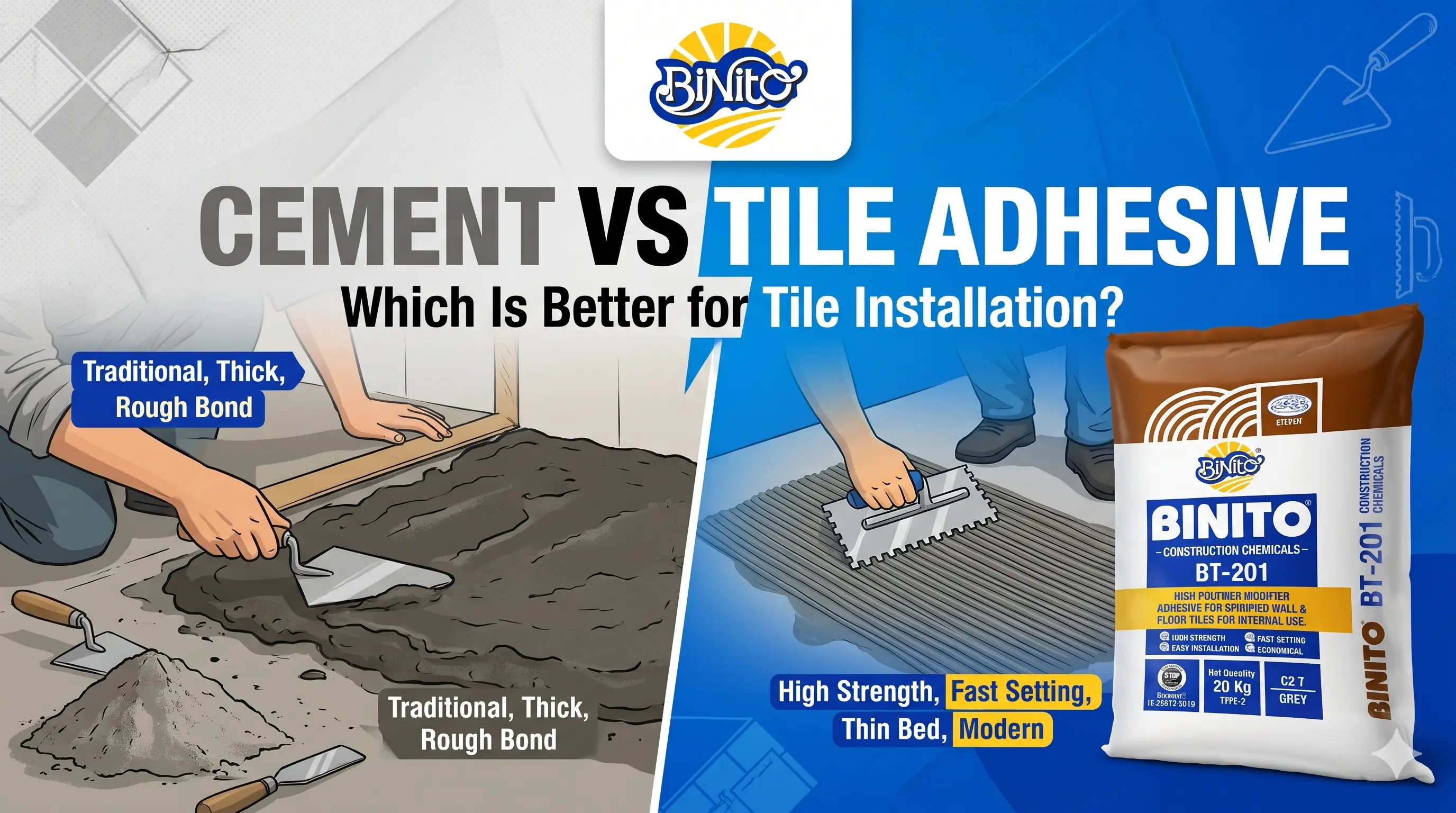
Cement vs Tile Adhesive: Which Is Better for Tile Installation?
Choosing the right material for tile installation is essential for achieving a strong bond, a professional finish and long-lasting performance. For many years, traditional cement-sand mortar has been widely used in residential and commercial construction. However, with the increasing popularity of porcelain, vitrified and large-format tiles, modern cement-based tile adhesives have become an important part of today's construction industry.
This brings up a common question among homeowners, contractors, builders and tile installers: Is traditional cement better, or should you use tile adhesive? Both materials have their own applications, advantages and limitations. The correct choice depends on the tile material, tile size, substrate condition, installation method and project requirements. In this guide, Binito® Construction Chemicals explains the difference between traditional cement-sand mortar and modern tile adhesive, helping you understand which solution is more suitable for your project.
1. What Is Traditional Cement-Sand Mortar for Tile Installation?
Traditional cement-sand mortar is a mixture of cement, sand and water used for various masonry and tile installation applications. It has been a common construction method for installing ceramic tiles and other suitable flooring materials.
How Does Cement-Sand Mortar Work?
Cement reacts with water through a hydration process and gradually develops strength. Sand provides bulk and helps form the mortar bed. In traditional tile installation, the mortar is prepared at the construction site and applied according to the selected installation method.
Advantages of Traditional Cement-Sand Mortar
- Familiar application method: Widely understood by traditional masons and construction workers.
- Readily available materials: Cement and sand are commonly available in the construction market.
- Flexible mortar-bed application: Can be used in suitable conventional bedding applications.
- Potentially economical: May be suitable for certain traditional installations, depending on local material and labour costs.
Limitations of Traditional Cement-Sand Mortar
- Inconsistent mixing: Site mixing can result in variations in cement-sand ratios and water content.
- Limited suitability for some modern tiles: Low-absorption porcelain and vitrified tiles may require a specifically formulated adhesive.
- Application dependency: Results depend heavily on workmanship, mortar preparation and installation technique.
- Thickness considerations: Traditional mortar-bed installation may require greater thickness than thin-bed adhesive installation.
- Not suitable for every substrate: Special surfaces and challenging installation conditions may require a different bonding system.
Traditional mortar is not necessarily unsuitable. It remains useful in applications where the installation method and material specifications permit its use.
2. What Is Tile Adhesive?
Tile adhesive is a specially formulated construction material designed to bond tiles to suitable floors and walls. Cement-based tile adhesives are generally supplied as dry powder mixtures containing cement, selected graded fillers and performance-enhancing additives. Water is added according to the manufacturer's instructions before application.
How Does Tile Adhesive Work?
When mixed with the recommended quantity of water, cement-based tile adhesive forms a workable mortar. It is generally applied to a properly prepared substrate using a notched trowel. The trowel creates uniform adhesive ridges that help achieve appropriate contact and coverage when the tile is installed using the recommended technique.
Advantages of Tile Adhesive
- Consistent formulation: Factory-controlled manufacturing helps maintain consistency between batches.
- Strong bonding performance: Available in different performance classes for different tile and substrate requirements.
- Thin-bed application: Many products allow installation without the need for a traditional thick mortar bed.
- Improved workability: Formulated for controlled application using suitable tools.
- Specialised solutions: Different formulations are available for ceramic, porcelain, vitrified and large-format tiles.
- Application-specific performance: Certain products offer reduced slip, extended open time and deformability.
Limitations of Tile Adhesive
- Correct selection is essential: Not every adhesive is suitable for every tile or substrate.
- Surface preparation is important: Weak, dusty or uneven surfaces can affect bonding performance.
- Mixing requirements: Incorrect water quantity or mixing technique can compromise performance.
- Working-time limitations: Prepared adhesive must be used within the manufacturer's specified pot life.
- Product cost: The purchase price per bag may be higher than conventional cement, but overall project cost should be evaluated rather than comparing bag prices alone.
3. Cement vs Tile Adhesive: Key Differences
Understanding the differences helps contractors and homeowners select the right installation material.
| Comparison Factor | Traditional Cement-Sand Mortar | Cement-Based Tile Adhesive |
|---|---|---|
| Composition | Cement, sand and water | Cement, graded fillers and selected additives |
| Manufacturing | Usually mixed at the construction site | Factory-formulated dry mix |
| Application | Depends on the mortar-bed method | Generally applied with a notched trowel |
| Bonding performance | Depends on mix and installation method | Designed to meet specified performance requirements |
| Tile compatibility | Depends on tile and installation method | Product-specific suitability |
| Porcelain tiles | May not be suitable for many applications | Suitable specialised products are available |
| Large-format tiles | Requires careful method selection | Specialised products are available |
| Workability | Depends on site mixing | Formulated for controlled workability |
| Application thickness | Depends on the bedding method | Generally designed for specified adhesive-bed thicknesses |
| Quality consistency | Depends on site preparation and mixing | Factory-controlled formulation |
| Cost comparison | May have a lower material purchase cost | Compare total installed cost and consumption |
Important: The performance of any installation depends on the complete system, including the substrate, tile, material selection and workmanship.
4. Which Is Better for Different Types of Tiles?
Ceramic Tiles
Ceramic tiles are widely used in residential floors, kitchens, bathrooms and commercial spaces. Suitable traditional installation methods may be used for certain ceramic tiles. However, cement-based tile adhesive offers a controlled alternative, particularly for thin-bed applications.
Recommendation: Select a suitable tile adhesive or approved traditional installation method according to the tile and substrate specifications.
Porcelain Tiles
Porcelain tiles generally have very low water absorption. This makes adhesive selection particularly important. A properly specified tile adhesive designed for porcelain tiles can provide the bonding performance required for the installation.
Recommendation: Use an adhesive specifically approved for porcelain tiles and the intended installation conditions.
Vitrified Tiles
Vitrified tiles are popular in modern homes, offices, hotels and commercial buildings. Their low water absorption and available large dimensions make it important to choose a suitable adhesive formulation.
Recommendation: Select a tile adhesive based on tile dimensions, substrate condition and application requirements.
Marble and Natural Stone
Natural stones have different physical and moisture-sensitive characteristics. Some varieties may be susceptible to staining or discolouration.
Recommendation: Use an adhesive specifically recommended for the particular stone. White adhesive or specialised stone-compatible formulations may be necessary.
Large-Format Tiles
Large-format tiles require proper substrate preparation and adequate adhesive coverage. An adhesive suitable for the tile size, weight and installation location should be selected.
Recommendation: Consider a suitable higher-performance adhesive and follow the tile and adhesive manufacturer's installation instructions.
5. Is Tile Adhesive Stronger Than Cement?
This is one of the most common questions asked by homeowners and contractors. The answer depends on what is being compared. Ordinary cement alone, cement-sand mortar and formulated tile adhesive are three different materials. A properly formulated tile adhesive contains carefully selected ingredients designed to improve its bonding and application characteristics. Depending on its classification and tested performance, it can offer bonding properties that are particularly suitable for modern low-absorption tiles and thin-bed installations.
However, it would be incorrect to claim that every tile adhesive is stronger than every cement-sand mortar installation. The actual performance depends on:
- Adhesive formulation and quality.
- Cement and aggregate characteristics.
- Tile absorption and surface properties.
- Substrate strength and preparation.
- Correct mixing and application.
- Adhesive coverage and installation technique.
- Environmental and service conditions.
For this reason, compare tested performance and application suitability rather than relying on general marketing claims.
6. Understanding Tile Adhesive Standards in India
When purchasing tile adhesive, it is important to understand the applicable quality and performance standards.
In India, IS 15477:2019 – Adhesives for Use with Ceramic, Mosaic and Stone Tiles is an important Indian Standard. It provides requirements for different adhesive types and performance characteristics.
The standard includes Type 1, Type 2, Type 3, Type 4 and Type 5 classifications, along with additional characteristics related to vertical application, slip resistance and deformability.
Some manufacturers also refer to EN 12004 classifications.
- C1: Standard-performance cementitious adhesive.
- C2: Improved-performance cementitious adhesive.
- T: Reduced slip.
- E: Extended open time.
- F: Fast setting.
- S1: Deformable adhesive.
- S2: Highly deformable adhesive.
These classifications belong to different standards frameworks and should not be treated as directly interchangeable.
When purchasing a tile adhesive, check the product packaging, technical data sheet, test reports and applicable certifications.
7. Cost Comparison: Cement-Sand Mortar vs Tile Adhesive
Cost is an important factor in construction decisions, particularly for large residential and commercial projects. Many buyers compare the purchase price of cement with the price of a tile adhesive bag. However, this does not provide a complete picture of the actual installation cost.
A better comparison considers:
- Material consumption per square metre.
- Cement and sand requirements.
- Adhesive consumption.
- Labour and installation time.
- Surface preparation.
- Installation thickness.
- Wastage.
- Risk of repair and replacement.
Why Comparing Bag Prices Can Be Misleading
A cement bag and a tile adhesive bag are not directly comparable because they have different compositions, application methods and coverage rates.
A 20 kg tile adhesive bag may cover a different area depending on tile dimensions, trowel notch, substrate flatness and application technique. Traditional mortar consumption depends on the thickness of the mortar bed and the cement-sand mix proportion.
Therefore, the most useful comparison is the total installed cost per square metre.
Which Option Offers Better Value?
For suitable traditional installations, cement-sand mortar may be economical. For modern porcelain, vitrified and large-format tiles, a correctly selected tile adhesive can offer better application suitability and a more controlled installation process.
8. Common Problems Caused by Incorrect Tile Installation
Hollow-Sounding Tiles
Hollow sounds may indicate insufficient adhesive contact or voids beneath the tile. Other installation factors can also contribute.
Loose or Detached Tiles
Poor substrate preparation, unsuitable adhesive, inadequate coverage or incorrect application can contribute to tile detachment.
Cracked Tiles
Cracking can result from substrate movement, structural issues, insufficient support, impact or installation defects.
Tile Slippage on Walls
Using an unsuitable adhesive for vertical installation can allow tiles to move before the adhesive develops sufficient holding strength.
Water Leakage
Tile adhesive alone does not provide a complete waterproofing system. Water leakage may occur when waterproofing, joints, drainage or detailing are inadequate. Correct material selection, substrate preparation and installation procedures help reduce these risks.
9. How to Apply Tile Adhesive Correctly
Even a high-quality tile adhesive requires correct installation practices. Follow these general steps:
- Prepare the surface: Ensure the substrate is sound, clean, sufficiently cured and free from dust, grease and loose material.
- Prepare the adhesive: Add the recommended quantity of clean water to the dry adhesive powder and mix according to the manufacturer's instructions.
- Allow the specified maturing time: Where instructed, allow the mixture to stand for the recommended period and remix before application.
- Apply the adhesive: Spread adhesive over a manageable area using the appropriate flat side of a notched trowel.
- Create uniform ridges: Use the notched side of the trowel to create consistent adhesive ridges.
- Place the tile: Position the tile within the adhesive's specified open time and press it firmly using the recommended technique.
- Check adhesive coverage: Periodically lift a tile during installation to verify coverage. Back-buttering may be necessary for certain large-format tiles and applications.
- Allow proper setting: Protect the installation and follow the manufacturer's instructions regarding grouting, foot traffic and service use.
10. When Should You Choose Cement and When Should You Choose Tile Adhesive?
| Project Requirement | Suitable Consideration |
|---|---|
| Conventional traditional mortar-bed installation | Cement-sand mortar, where the method is appropriate |
| Standard ceramic tiles | Suitable mortar or tile adhesive |
| Low-absorption porcelain tiles | Specifically approved tile adhesive |
| Vitrified tiles | Suitable tile adhesive |
| Large-format tiles | Specialised adhesive selected for tile dimensions and application |
| Heavy wall tiles | Suitable reduced-slip adhesive with verified application suitability |
| Natural stone | Stone-compatible adhesive |
| Wet areas | Suitable tile adhesive plus a separate waterproofing system where required |
| Exterior tiling | Adhesive specifically approved for the exterior application |
There is no single solution for every tiling project. The material must match the tile, substrate and environmental conditions.
Frequently Asked Questions (FAQs)
1. Is tile adhesive better than cement for fixing tiles?
For many modern tiling applications, particularly porcelain, vitrified and large-format tiles, a suitable tile adhesive offers advantages in bonding performance, workability and application consistency. Traditional cement-sand mortar can still be appropriate for certain conventional installation methods.
2. Can I use normal cement to fix floor tiles?
Normal cement alone is not generally recommended as a substitute for a properly designed tile installation system. Cement-sand mortar may be used in suitable traditional applications, while many modern tiles require a compatible formulated adhesive.
3. Is tile adhesive suitable for bathroom tiles?
Yes, provided the selected adhesive is suitable for the tile and wet-area application. A separate waterproofing system should be used wherever required.
4. Can tile adhesive be used for vitrified tiles?
Yes. Select an adhesive specifically recommended for vitrified tiles and suitable for the substrate and installation conditions.
5. Which is more economical: cement or tile adhesive?
Traditional mortar may have a lower initial material cost in certain applications. However, total installation cost should include material consumption, labour, preparation, wastage and potential repairs.
6. Can tile adhesive be applied directly to concrete?
Many tile adhesives can be applied to suitable concrete substrates, provided the concrete is sufficiently cured, sound, clean and properly prepared according to the manufacturer's instructions.
7. Does tile adhesive require curing?
Cement-based tile adhesive develops strength through cement hydration. Follow the manufacturer's instructions for setting, grouting, traffic and protection. Do not apply additional curing water unless specifically instructed.
8. How thick should tile adhesive be applied?
Application thickness depends on the product, trowel, tile dimensions and substrate. Follow the manufacturer's specified thickness and application method. Do not use excessive adhesive to correct major substrate irregularities.
9. Why is tile adhesive recommended for porcelain tiles?
Porcelain tiles have low water absorption. A suitably formulated adhesive provides the bonding characteristics required for these tiles when installed according to the manufacturer's instructions.
10. How do I select the right tile adhesive manufacturer?
Look for consistent product quality, relevant certifications and test documentation, clear technical data sheets, application guidance, product availability and reliable technical support.
Conclusion: Make the Right Choice for Long-Lasting Tile Installation
Both traditional cement-sand mortar and modern tile adhesive have their place in the construction industry. The important thing is understanding their differences and selecting the correct material for the specific installation.
For many modern tiling projects involving porcelain, vitrified, large-format and specialised tiles, a suitable cement-based tile adhesive offers important advantages in controlled application, bonding performance and product consistency.
However, even the best adhesive cannot compensate for poor surface preparation or incorrect installation practices.
At Binito® Construction Chemicals, we believe that strong construction begins with the right materials, reliable product performance and proper application.
Choose the right tile adhesive for your project and build with confidence.
Binito® Construction Chemicals
Engineered for Strength. Formulated to Last.
Explore construction chemical solutions and product information at Binito Construction Chemicals.